Scott Britton has a long track record in sales and business development, he worked on the start-up team with Single Platform (sold for $100 million). In September 2013, he left the New York tech scene and moved to Rio de Janeiro, Brazil, where he lives with a group of entrepreneurs all building out their lifestyle businesses. He’s now focused on scaling up his information product business, and he’s a master of creating fantastic, highly successful Udemy courses including Sleep Hacking, Cold Emailing for Startups, and Gmail Hacking.

You can learn all about Scott on his personal website where he talks about business, personal development, and many more topics! You can also take a look at all his amazing online courses there as well!

In this call Scott Britton joins us from his flat in Rio de Janeiro and we discuss: 

  • What he’s been doing recently
  • His path from working for an athlete representation agency to breaking into New York’s start-up scene
  • How you can provide an astonishing amount of value to people through curation
  • The hard decision to make the leap from the “bubble” in New York City down to Brazil
  • His daily routine for self-improvement now that he’s living in Rio de Janeiro
  • The many benefits of surrounding yourself with like-minded people and how it helps elevate you and your goals
  • Mentioned: Charisma on Command, the project being worked on by one of his flatmates in Rio de Janeiro
  • The positive aspects of travel and living abroad with the right people
  • How he got started crafting highly successful information products
  • His Lifehacks book, BD Playbook, and Break into Biz Dev products…
  • Mentioned: Skillshare and Udemy
  • His thought process behind crafting and digitizing courses that continue to earn passive income from information you already know
  • About his Udemy courses – Sleep Hacking, Master Gmail, Cold Emailing for Startups, and Land a Startup Job
  • Strategies for utilizing Udemy effectively and utilizing it for lead generation
  • The Bandage Email Framework and straightforward tactics for “cold emailing” contacts that are often overlooked
  • His personal goals and tools and systems for progressing towards and tracking goals
  • Best practices for juggling multiple goals and personal experiments at once
  • How you handle cold emails that require a sales call to close
  • And much, much more…

Derek Sivers, who I first met in Singapore in 2011, is a fascinating person who I really look up to — a hugely successful writer, entrepreneur, programmer, and ex-musician who founded CD Baby, and in 2008 sold it for $22 million.

Derek is hugely passionate about learning and teaching, he’s a frequent TED speaker, and writes extensively at Sivers.org. He’s also the author of Anything You Want and the Wood Egg startup guide series.

Below is my 2014 mentor call with him just for members, perhaps the best guest we’ve ever had! Watch to learn how Derek transitioned from overworked running a huge multimillion dollar business with 85 employees to resetting his operating system, how he then sold his $22 million dollar enterprise without paying anything in taxes, and his philosophies on how to have FUN doing business:

In this call, Derek joins us from his home in New Zealand and we discuss:

You can learn much more about Derek on his site, read his latest articles, and watch his great videos from the Anything You Want book and Uncommon Sense series.

Rolf Potts VagabondingRolf is a high-profile proponent of independent travel and acclaimed author of the book Vagabonding: An Uncommon Guide to the Art of Long-Term World Travel — one of the two books, alongside Tim Ferriss’ The 4-Hour Workweek, that inspired my nomadic lifestyle. He also authored Marco Polo Didn’t Go There: Stories and Revelations from One Decade as a Postmodern Travel Writer and is an accomplished travel journalist who’s reported from over 60 countries and written for National Geographic Traveler, The New Yorker, Slate, Lonely Planet, Outside, The Guardian, the Travel Channel and much more, he’s an explorer who’s adventures have taken him across 6 continents.

You can learn much more about Rolf on his bio site and at Vagablogging, and get your hands on his exclusive bundle of free content from BitTorrent to celebrate the release of the new audiobook.

In this call, Rolf phoned in from his family farm in Kansas and we discuss:

  • Find out the one continent he hasn’t been to yet.
  • The similarities between a travel lifestyle and entrepreneurship…
  • Learn how living out of a van in 1994 helped give him the long-term travel itch.
  • The idea of “home” for a long-term perpetual traveler, and places we love to live.
  • Why it’s important to take control of your circumstances rather than being passive in life.
  • What it means to develop an “uncommon way of looking at life” and how you choose to use your time…
  • How travel has changed Rolf’s worldview and what he’s capable of…
  • How much time he recommends people take off for a RTW trip or a sabbatical…
  • The challenges of re-assimilating back into ordinary life.
  • Mentioned: Vagabonding resources and Rolf’s favorite travel quotes
  • What is a “Postmodern Travel Writer”? and we talk about some of the writers of the past who he admires most.
  • What value does travel have to the student of life as opposed to a traditional educational experience?
  • About working with Tim Ferriss to release the audiobook version of Vagabonding for the first time…
  • and much much more…

Find Rolf at rolfpotts.com and vagabonding.net and if you have questions for him, email [email protected]

Also be sure to listen to our past interview with Rolf Potts, in which we dig deep into the ins and outs of becoming a successful travel writer.

Cody McKibben hosts a discussion with Skinner Layne and Carlos Miceli, co-founders of Exosphere, about the state of higher education and entrepreneurship, emphasizing the need for lifelong learning and community-driven support for entrepreneurs. They introduce an upcoming entrepreneurship bootcamp in Santiago, Chile, which aims to provide participating startup founders with practical skills, mentorship, and a strong community to foster personal and professional growth. The conversation also touches on the importance of self-directed education, the challenges of traditional educational systems, and the value of creating new opportunities for learning and entrepreneurship.

Listen in to this enlightening call to learn:

  • Do you think traditional higher education is broken??
  • The importance of lifelong, self-directed education
  • Why the You that you can create is much more interesting than the You that you believe you can discover
  • About the Exosphere idea lab, lean startup classes and events
  • Benefits of Entrepreneurship – self-reliance, resourcefulness, adapt to change, expand your sphere of influence…
  • Mentioned: The Fourth Economy, The Road Less Traveled by M. Scott Peck, AntifragileThe Start Up of You by Reid Hoffman, The Personal MBA

Since being back here in the States, I’ve spent a lot of time talking with old friends and I’ve heard time and time again how difficult it is for young, college-educated people to find and maintain good, reliable, consistent work opportunities.

My friend Craig, an ex-marine, was just telling me last night at the bar how everyone from private security companies to police departments are expecting to recruit people for $12-14 dollars an hour. To get shot at.

A lot of my friends have said they admire my dedication to build something of my own (even if it means I might not have as much income temporarily while I bootstrap and struggle through the regular challenges of an entrepreneurial life) and my willingness to go abroad to do it in a new way and seek opportunities overseas.

For the first time ever, our generation is expected to earn less money, have fewer opportunities, and basically struggle to maintain a career, compared with our parents. And we’re probably the most educated generation in history, too! We spend all this money getting degrees and credentials and approval, but in the end what nobody reminds you of is that none of it guarantees a good job market.

I cringe when I hear people I care about talk about going back to school because they’re having trouble finding a job, or because they feel like they need more “qualifications”. My attitude these days is that, if you know where to look, there’s actually so much opportunity to get in with people who are doing it, and that (in most industries) it’s better to save the $60K+ you’ll spend on a Master’s degree and invest those years of your time and effort into actually building connections in your chosen field, seeking out mentors and internship opportunities, and getting some real-world experience under your belt.

In fact, here’s two great opportunities right now with a few trusted friends of mine.

In some fields, you might absolutely need the degree, but in a lot of areas you can actually get a foot in the door and start to build a reputation for yourself without having to get a university’s “permission”.

And as we continue to become more and more educated, at the same time as we’re competing on a global scale with cheap labor overseas, there’s actually no better way to find great opportunities than to look for it abroad!

Asia and South America are still quickly growing. That’s why somebody decided to label them the “developing world”.

For a young person today with a Western education and a bit of ambition, there are innumerable opportunities to find work with companies abroad, or even to seize upon your own opportunities and quickly build a business overseas.

Michael Park recently shared about the impressive career opportunities available in these growing economies, and the leg up that living abroad can give you if you’re motivated to learn, grow, develop yourself, and stand out in the marketplace.

Today I’ve got a guest video for you from entrepreneurs Tim Nybo and Nick Ramil. These two have been abroad for a while now, going through the hoops of learning how to fit into a new culture and putting all their time and energy into building a business in a foreign country.

They knew the traditional route after university wasn’t for them, so they decided to explore opportunities abroad. Now, you can find them in Guangzhou, China, working on a range of projects and helping others establish new businesses there too!

5 Questions To Ask Yourself To See If You’re Cut Out To Be An International Entrepreneur

Do you think you have what it takes to be an international entrepreneur?  Be sure to answer these five questions before you make the big leap!

Watch now to learn the special characteristics we see in every international entrepreneur we meet from around the globe.  It takes a certain type of person to survive abroad, and we hope you’re one of them!

A couple important takeaways:

  • It’s not a vacation
  • You have to be comfortable with taking risks
  • You’ve gotta remain optimistic through the challenges

Are you itching to make the jump? Or have you forged your own path as an entrepreneur abroad? Share your story in the comments below.

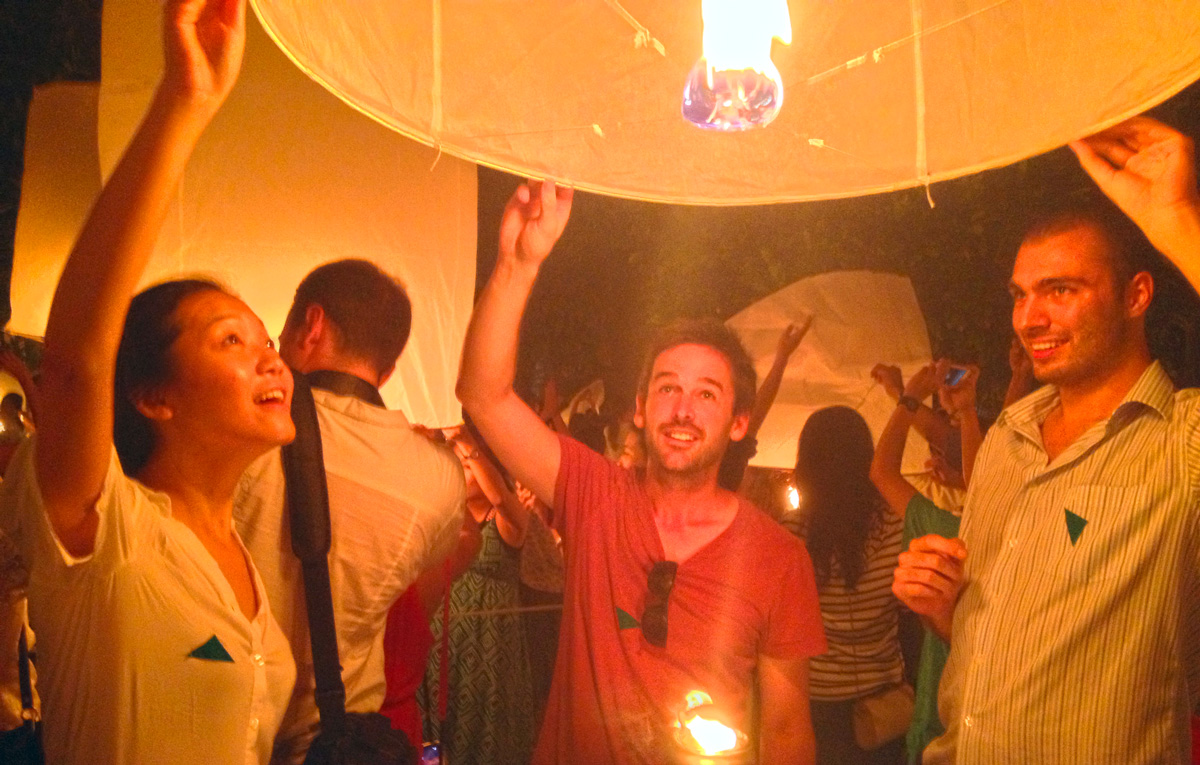
Every year during the Thai Loi Krathong holiday, here in Chiang Mai in the north of Thailand, the Lanna (northern Thai) festival “Yee Ping” takes place at Mae Jo. The streets are decorated with lights and lanterns, and here, many thousands of beautiful Lanna-style floating lanterns (khom loi) are launched into the air simultaneously, creating a starfield of glowing fire and sky lanters over Chiang Mai.

This is what I missed my 10-year high school reunion for.

If you get a chance, nothing compares to witnessing this spectacle with your own eyes, but if you missed this year’s event or you don’t want to spend the hundred dollars or so for the trip up north to Mae Joe, here’s a short video compilation so you can see it for free!

Many thanks to Stacey Herbert for some of the great still photos!

Make sure you stay til the end for fireworks!!

If you enjoy this…

Come join us in the REAL Magical Kingdom

…this January 7th, 2019 in Thailand for a transformative 5-day Hero’s Journey immersion with fellow entrepreneurs and creatives. Click here to learn all about our upcoming HERO Week  Leadership Retreat!

I’ve been wanting to share a lot more here about the people and stories I find truly fascinating and inspiring.

The first on that list is someone very unique that I’d like to shine a spotlight on:

My closest friend in Bangkok — Dwight Turner — is the crazy changemaker behind the grassroots volunteer organization In Search of Sanuk (2016 update: now ‘Courageous Kitchen’)

He is an inspirational and unique character in the strange chaotic melting pot that is Southeast Asia. His love for others, and his dedication to helping children and families in need shines brilliantly in the darkness.

If you’ve been following me here at Thrilling Heroics for long, you will have seen his name before, but somebody with some skill finally picked up a video camera and followed him around Bangkok to get a real tactile feel for what he’s doing to make this little corner of the world a better place, working hard to help urban refugees in Thailand.

I’ll let this quick 4-minute documentary speak for itself, so watch it. If the video doesn’t appear for you, click here to watch it. It’s only a few moments of your time, and I promise it will be well spent.

To me, Dwight is a shining example of the entrepreneurs — or social inventors — who are creating new realities that will shape the next century. 

He’s a selfless, hard-working global citizen who genuinely cares about making the world a better place, and people like him are doing it, one little bit at a time.

If this short documentary has you inspired, then find out more about Dwight’s project and begin your unconventional giving by donating today. Give just a few dollars, a small sum that could very well have a major impact on the lives of an underprivileged family living in poverty.

Dwight is just the first of many incredible social inventors and changemakers who we will highlight here at Thrilling Heroics… But  Bangkok certainly wouldn’t be the same without him.

You can also see the part In Search of Sanuk had in changing our good friend Ryan’s life, as just one example.

Help Courageous Kitchen (previously ‘In Search of Sanuk’) hit their “Fun-Raising” goals for 2012 by making a one-time or monthly donation here through PayPal.

If you’re feeling generous like I am, then let’s share with Courageous Kitchen to help them continue the good work they’re doing to improve lives in Bangkok.

Go here to make a donation.

A few weeks ago, my old blogging buddy Ron Davison sent me a copy of his new book The Fourth Economy: Inventing Western Civilization, which examines the pattern of progress from an agricultural economy to an industrial one, then from industrial to an information economy, and predicts what the next generation will see with the rise of an entrepreneurship economy. If you feel the same entrepreneurial rumble around you right now as I do, we’re only just seeing the tip of the iceberg.

Already in the first few pages it had me absolutely spellbound, so I wanted to share. Ron’s thesis revolves around how the evolution of society has always depended upon invention… but he points out how we tend to think of invention solely as a technological act… when in fact there is another, equally important form of invention that almost invisibly shapes society: social invention.

I’ll quote extensively from Ron’s first few chapters, as he’s much more eloquent and academic about this important claim than I could ever be (emphases are mine):

“Money is only money because we agree it is money. As soon as we all agree that Confederate currency no longer has any value, it no longer has any value. When we agree that information on magnetic strips affixed to plastic has value, it has value. Whether someone is a slave, employee or part-owner of an enterprise is not inherent in any physical reality or dependent on any brute facts, but is—instead—true only as an institutional fact [i.e., a social invention –Cody].

[…] “A technological invention results in a product that can be seen independent of any agreement about it. While its use might require some instruction, instruction that might be something akin to declaration or agreement, its existence does not. A steam engine translates heat into motion and even if it requires an operator to do this, its existence falls more into the category of brute fact than institutional fact. By contrast, a home loan is a [social invention]. Without a contract specifying terms and even who owes what to whom, the loan makes no sense. Further, the loan assumes a whole other set of [social inventions], from money to banks to a real estate market to determine the value of the home for which the loan exists.”

…Ron goes on to explain the immense importance of social invention, including all the institutions that you’ve become accustomed to in your lifetime, in shaping society — nation-states, churches, banks, corporations, money, democracy. At some point in history, each of these things was invented, agreed upon, and eventually accepted as the status quo. But these things haven’t always existed, they haven’t always been the norm, as we tend to forget.

“A set of inventions defines a culture or civilization.

We recreate civilization in each child. We call it education. Look at the huge amount of time and attention we devote to ‘civilizing’ a baby to become a member of society. The gross effort it takes to recreate society in each child should be testament to the fact that a culture is not a ‘natural’ or spontaneous state; it is, instead a social invention that takes great effort—every time. Language and manners, what we question and what we accept, social roles—all of these end products represent the teaching of parents, teachers, and even the media and are essentially conventions that work to construct meaning, to create the modern life. Rather than see them as inventions, we often see social inventions as simply ‘the way things are.’ Should you want a reminder that social inventions are just made up, however, raise a child. Mothers know that the curious, rebellious, stubborn, and lazy child will challenge social inventions. My family lives close to the Mexican border and when my daughter was protesting her car seat, she would say, ‘Mexican kids don’t wear seat belts.’ She, like every child, knew that things could be different and questioned why they were not. And of course, travel, news reports, novels, and history all remind us that our social inventions are not universal or even stable. What makes you successfully fit into your neighborhood in Manhattan would make you stand out in Afghanistan. Or even Montana. What made you fashionable in 1972 makes you look silly in 2012.”

He implores the need for social progress, for us to become more conscious about social invention. And I love how he describes our opportunity to create a new social reality:

“Perhaps teachers and parents should add this to their list of admonitions and lessons: ‘Warning: contents of this society have been known to create feelings of anomie and alienation; provoke wars, homicides, and suicides; and pollute the habitat you need for survival. Most of what we tell you should be questioned and could be improved upon. This is, really, just the best we’ve been able to do up until now and it could be that improvement will actually overturn much of what we now accept and advocate. Learn about your culture and your place in it, but don’t cling too tightly to it. What we’re teaching you probably needs to change, and soon.'”

[…] “a hypnotist, in a matter of minutes, can program you to do things you don’t normally do and to believe what is not so. […] how much more powerfully can society program you during the course of your life, given that it has so much more time and so many more persuasive tools at its disposal than does a hypnotist?”

[…] “If social invention is to become more widespread [ie: and we are to harness our inherent abilities to pave our own destinies and craft our own world –Cody], the individual will have to become more aware of how his or her life is also an invention. Up until now, it is the few who have defined society and the many that have been defined by it. A few receive the divine revelation and many receive Mass. Think about a world in which the direction is increasingly reversed, a society in which the individual is less social invention than social inventor. Or, rather, imagine a world in which more people engage in acts of social invention. If social invention becomes to this century what technological invention was to the last, we’ll witness such a change. Or, rather, we’ll create such a change.

“If daily life is an invention, the question is, whose invention is it? It is hard to underestimate the importance of inertia in defining society. Yet entrepreneurs challenge this inertia and invent something new.”

[…] “an entrepreneur is a social inventor. Their work is to create a new social invention, an organization, an institution, a new market, or a new business. Social entrepreneurs might start a new non-governmental organization (NGO) or nonprofit or charter school. I’m going to include under my broad umbrella of entrepreneurs not just business entrepreneurs like Bill Gates and Henry Ford but political and religious entrepreneurs like Thomas Jefferson and Martin Luther.

“The next economy will popularize entrepreneurship in the same way that the Information Age popularized higher education and knowledge throughout the twentieth century. As entrepreneurship becomes more popular and diverse in its expression and application, social invention will become as normal as technological invention.”

My wish for the years ahead is to see more interesting people building interesting things — projects, businesses, organizations, art, nonprofits, social inventions…

I am excited to see this become the new norm — to see many more people wake up to the realization that they don’t have to be a wage slave or an employee, but can instead choose to be creators, artists, shapers of the world around them, entrepreneurs. If you find these ideas and trends as fascinating as I do, I highly recommend you pick up a copy of Ron’s book The Fourth Economy for a much more in-depth look at the entrepreneurial revolution he predicts will sweep across the world.

I only hope we can play a small role in this huge societal shift with what we’re doing here and at inside The HERO Project, by enabling many more ambitious trailblazers to use their inherent abilities to create and shape things around them to help move the world forward.


You are the pioneers of the Fourth Economy. Here’s to creating an improved, more connected, whole, healed, better society through entrepreneurship! 

Rolf Potts VagabondingRolf is one of the most accomplished travel journalists of our time, having reported from over 60 countries for major venues like National Geographic TravelerThe New YorkerOutside, and the Travel Channel. He is a high-profile proponent of independent travel. His book Vagabonding: An Uncommon Guide to the Art of Long-Term World Travel was one of only four “fundamental books” Tim Ferriss mentioned in The 4-Hour Workweek, and was one of the two main sources of inspiration behind my nomadic lifestyle. His second book, Marco Polo Didn’t Go There, details personal anecdotes from 10 years of traveling and travel writing. With his extensive experience traveling on a shoestring, Rolf shows how nearly anyone can achieve the dream of extended overseas travel.

You can learn much more about Rolf on his bio site and at Vagablogging.

In this call, Rolf phoned in from Philadelphia (where he’s currently a writer-in-residence at University of Pennsylvania) and we discuss:

  • Rolf’s past life prior to writing two acclaimed books
  • His 2 years spent teaching English in Korea
  • The impetus for writing Vagabonding and his philosophy behind the book
  • Mentioned: Walt Whitman, other favorite books and sources of inspiration: vagabonding.net/resources
  • How living out of a van, traveling around the US in 1994 helped give him the long-term travel itch
  • How Rolf went from first published article to his first book deal in less than 2 years, and his advice for those seeking to get a book deal and agent
  • Mentioned: Rick Steves, also Travel Writing 2.0 by Tim Leffel
  • Great places for generating online buzz: The Guardian, San Francisco Chronicle, New York Times, and networking in the travel & lifestyle design blogging community. Make yourself very accessible on your blog…
  • “To become a good travel writer,  you need expertise.” Rolf recommends travel blogging, infusing your writing with personality, being as engaging as possible, and wise use of free content online to get your name out there. Listen in for much more…
  • How to avoid being a walking dollar sign when you travel in developing countries
  • Is there a rule-of-thumb for avoiding the typical tourist route and traveling to places that are not full of tourists, where you can find a more non-commercialized or unique experience?
  • All about Rolf’s workflow, how he finds the motivation to keep working even after becoming a stunning success (and being featured in interviews and media all over the internet and the world), and how to maintain discipline as a freelancer
  • About the sacrifice of traditional stability, home & family, and how to tell your family you’re going off to travel long term (note: it wouldn’t hurt to give them a copy of Vagabonding)
  • How Rolf started the No Baggage Challenge in 2010—traveling light to 12 countries on 5 continents
  • Mentioned: luggage-less traveler Jonathan Yevin
  • Lessons learned in hyper-minimalism: don’t weigh yourself down with things. And what items does Rolf now travel with and consider essential?
  • About the writing workshop Rolf runs in France every July at the Paris American Academy
  • Why he loves Bangkok and why revisiting Khao San Road feels like going back to kindergarten
  • and much much more…

This was a great one, so make sure you give it a listen! Find Rolf at rolfpotts.com and vagabonding.net and if you have questions for him, email [email protected]

I was on a live mentorship call with several students last week and the subject of niche finding came up. Our program’s foundation starts with extensive coursework that delves into your behaviors, your priorities and mindset, and your resource allocation (of  your time and money) before narrowing in on ideal customers, their biggest profitable problems, solving their pain points, and business development.

Anyone who’s seeking to match (or supplement) their existing income from a job with online passive income is always worried about finding their niche.

One major problem is, most people are looking for the “magic bullet” — the one online niche that’s gonna be their gravy train to online riches! And another huge problem is that many courses and products online are promising these shortcuts to online riches!

Three short months to a complete lifestyle makeover! Earn your first cool million by next Tuesday!

In this lively interview, you will learn, as David Walsh says, the closest thing to a “magic bullet” in business is PROVEN. SYSTEMS.

I’ve known David for quite a while now, since his early days with his great site MuseLife. He attracted my attention in a major way with his first ebook on outsourcing, in which he broke down how to implement systems in your business.

David and partner Derek Johanson bring several solid years of experience to the table developing, designing, and launching information products and courses online, and their new framework for product creation is the evolution of everything they’ve learned.

These two teamed up to create their own online publishing company, Dangerous Publishing, and now what they’re basically doing is systematizing everything you need in order to start earning passive income with your own online information product empire!

David and Derek spent several months in Bangkok alongside me and other nomadpreneurs while they were working diligently developing this new “M6” framework, and they’re finally just starting to share their production methods more publicly.

It’s been ages since we were dodging bullets in Bangkok and civil protests tore us apart though, so I wanted to track them down to discuss finding a niche and creating info products.

If you’re an ambitious young upstart, motivated to start your own passive online business, then I guarantee you’ll find these 47 minutes very interesting. A few things mentioned in the video interview:

  • Derek & David’s travels (enabled by their passive online income)
  • how they’re changing the publishing industry
  • what they’ve learned in two years creating great information products
  • how David built himself out of a full-time job (the importance of systems)
  • one of the great M6 Method success stories: The Hollywood Physique
  • how to find a product niche & how to keep an eye open for opportunities
  • why you should test your product before you create it

If you don’t see the video above, click here to watch it on Vimeo.

David and Derek are truly two of the smartest guys I know when it comes to turning knowledge into marketable products, and turning digital products into low-maintenance, passive income streams.

Update: M6 Method has now been discontinued.

But if you want to start creating your own digital products or launch a solopreneur/coaching career, join our private HERO Foundry Accelerator network where you’ll join a trusted small circle of elite entrepreneurs developing and launching product-based online businesses.

Start building something!